Mar 14, 2013

Meditación y budismo en Yoga Sala


Clases de Meditación y Budismo

Estás clases son ideales para acercarse a la meditación. Son claras, amenas y sobre todo muy prácticas a la hora de ayudarnos a liberarnos del estrés y desarrollar estados mentales apacibles. Incluyen una meditación guiada, una enseñanza y un espacio para debatir y llegar a conclusiones. No es necesario tener experiencia previa y te puedes incorporar en cualquier momento.
Maestro
El curso será impartido por el monje budista Guen Kelsang Tharpa
Maestro residente del Centro Kadampa de Meditación de España
Hora: 19:30 a 21:00
Lugar: Yogasala C/Moreno Monroy 5. Planta 3ª (Málaga)

Precio: 6 €
Más información en:

Apr 30, 2012

Buddhist Meditation Classes


Every Thursday at 8 p.m.

Classes for Everyone with Teachings & Guided Meditations

Meditation helps us develop inner peace and qualities to take life in a more constructive manner.
 
These classes include Buddhist teachings, guided meditations and practical advice for daily life.

They are designed for everyone including those that have no previous experience.

                                 
          Classes start on the 24th January
    Classes are weekly and will run until June


Imparted by:
Kadampa Meditation Centre Teachers


At:
Integral Yoga Centre
33 Town Range
Gibraltar

Donations: £5
All proceeds for charity (Integral Yoga Centre & International Temple Project)

Information: +350 56000231


Jan 11, 2012

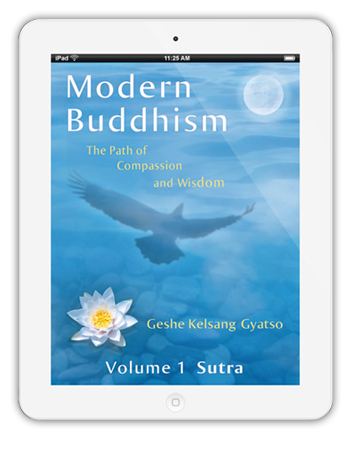
Modern Buddhism - Free ebook

Introduction and Encouragement
This eBook Modern Buddhism – The Path of Compassion and Wisdom, in three volumes, is being distributed freely at the request of the author Geshe Kelsang Gyatso. 

The author says: "Through reading and practicing the instructions given in this book, people can solve their daily problems and maintain a happy mind all the time." So that these benefits can pervade the whole world, Geshe Kelsang wishes to give this eBook freely to everyone.We would like to request you to please respect this precious Dharma book, which functions to free living beings from suffering permanently. If you continually read and practice the advice in this book, eventually your problems caused by anger, attachment and ignorance will cease. 

Please enjoy this special gift from Geshe Kelsang Gyatso, who dedicates: "May everyone who reads this book experience deep peace of mind, and accomplish the real meaning of human life."


Jan 8, 2012

Kadampa Buddhist Temples

Kadampa Buddhist Temples

A Kadampa Buddhist Temple is a special, holy place, where we can receive blessings and powerful imprints on our minds that lead to deep inner peace in the future.
Many Kadampa Temples are being built around the world as part of the International Temples Project.
Kadampa Buddhist Temples take many forms. Some are custom built according to a special design developed by Geshe Kelsang based on traditional Buddhist architecture, such as the Mother Temple at Manjushri Kadampa Meditation Centre in England and the Temples in New York, and  São Paulo.
Others are adapted from existing buildings acquired for Kadampa Meditation Centers around the world, such as the Temples in Toronto, Le Mans, Berlin, Zurich, Texas, and Melbourne. Yet others are incorporated within Hotel Kadampas, such as those in Málaga and Tuscany.
Many more Temples are planned throughout the world.
Whatever form they take, Kadampa Temples are holy places open to everyone to enjoy. They are Pure Lands in our troubled world – offering doorways to inner peace for all who visit them.

Pure land

Venerable Geshe Kelsang Gyatso explains that at first a Temple is a representation of a Pure Land, such as Tushita Heaven where Je Tsongkhapa abides, or the Pure land of Buddha Heruka and Vajrayogini.
Eventually, however, through the force of all the pure practices and sincere prayers performed in it and the blessings of the Holy Beings, the Temple becomes an actual Pure Land.

Blessed statues

Kadampa Temples all house beautiful shrines in which you can see magnificent statues cast in Kadampa Studios. Just seeing these blessed statues places powerful imprints on the mind to experience deep inner peace in the future.
The Temples are open to the public for both private and group visits. Information on local visiting times can be found on each Temple’s website (see menu).

Annual events

Kadampa Temples are international establishments and each year they host major gatherings such as Dharma Celebrations, National Festivals, and International Festivals.

Oct 20, 2011

Sitting in Meditation

When we practice meditation we need to have a comfortable seat and a good posture.

The most important feature of the posture is to keep our back straight. To help us do this, if we are sitting on a cushion we make sure that the back of the cushion is slightly higher than the front, inclining our pelvis slightly forward.

It is not necessary at first to sit cross-legged, but it is a good idea to become accustomed to sitting in the posture of Buddha Vairochana. If we cannot hold this posture we should sit in one which is as close to this as possible while remaining comfortable.

The seven features of Vairochana’s posture are:

1 The legs are crossed in the vajra posture. This helps to reduce thoughts and feelings of desirous attachment.

2 The right hand is placed in the left hand, palms upwards, with the tips of the thumbs slightly raised and gently touching. The hands are held about four fingers’ width below the navel. This helps us to develop good concentration. The right hand symbolizes method and the left hand symbolizes wisdom – the two together symbolize the union of method and wisdom. The two thumbs at the level of the navel symbolize the blazing of inner fire

3 The back is straight but not tense. This helps us to develop and maintain a clear mind, and it allows the subtle energy winds to flow freely

4 The lips and teeth are held as usual, but the tongue touches against the back of the upper teeth. This prevents excessive salivation while also preventing our mouth from becoming too dry

5 The head is tipped a little forward with the chin slightly tucked in so that the eyes are cast down. This helps prevent mental excitement

6 The eyes are neither wide open nor completely closed, but remain half open and gaze down along the line of the nose. If the eyes are wide open we are likely to develop mental excitement and if they are closed we are likely to develop mental sinking

7 The shoulders are level and the elbows are held slightly away from the sides to let air circulate

What to Meditate On

In general, any virtuous object can be used as an object of meditation.

If we discover that by acquainting our mind with a particular object our mind becomes more peaceful and virtuous, this indicates that for us that object is virtuous. If the opposite happens, for us it is a non-virtuous object. Many objects are neutral and have no particular positive or negative effect on our mind.

There are many different virtuous objects of meditation, but the most meaningful are the twenty-one objects of Lamrim meditation:
  1. Our precious human life
  2. Death and impermanence
  3. The danger of lower rebirth
  4. Refuge practice
  5. Actions and their effects
  6. Developing renunciation for samsara
  7. Developing equanimity
  8. Recognizing that all living beings are our mothers
  9. Remembering the kindness of living beings
  10. Equalizing self and others
  11. The disadvantages of self-cherishing
  12. The advantages of cherishing others
  13. Exchanging self with others
  14. Great compassion
  15. Taking
  16. Wishing love
  17. Giving
  18. Bodhichitta
  19. Tranquil abiding
  20. Superior seeing
  21. Relying upon a Spiritual Guide
We need to meditate on our precious human life to realize that we now have a special opportunity to practice Dharma. If we appreciate the great potential of this life we shall not waste it by engaging in meaningless activities.
We need to meditate on death and impermanence to overcome procrastination, and to ensure that our Dharma practice is pure by overcoming our preoccupation with worldly concerns. If we practice Dharma purely it is not very difficult to attain realizations.
By meditating on the danger of lower rebirth, taking refuge sincerely, and avoiding non-virtue and practicing virtue, we protect ourself from taking lower rebirth and ensure that life after life we shall obtain a precious human rebirth endowed with all the conditions conducive to the practice of Dharma.
We need to meditate on the sufferings of humans and gods so that we develop a spontaneous wish to attain permanent liberation, or nirvana. This wish, known as ‘renunciation’, strongly encourages us to complete the practice of the spiritual paths, which are the actual methods for attaining full liberation.
We need to meditate on love, compassion, and bodhichitta so that we can overcome our self-cherishing and develop and maintain a good heart towards all living beings.
With this good heart we need to meditate on tranquil abiding and superior seeing so that we can eradicate our ignorance and finally become a Buddha by abandoning the two types of obstruction.
By relying upon a qualified Spiritual Guide we open the door to practicing Dharma. Through the blessings of our Spiritual Guide we generate faith and confidence in our practice, and easily attain all the above realizations of the stages of the path. For these reasons we need to meditate on relying upon a Spiritual Guide.
These meditations, along with instructions on how to practice and essential background material can be found in The New Meditation Handbook.

The Purpose of Meditation

The purpose of meditation is to make our mind calm and peaceful.

If our mind is peaceful, we will be free from worries and mental discomfort, and so we will experience true happiness; but if our mind is not peaceful, we will find it very difficult to be happy, even if we are living in the very best conditions.

If we train in meditation, our mind will gradually become more and more peaceful, and we will experience a purer and purer form of happiness. Eventually, we will be able to stay happy all the time, even in the most difficult circumstances.

Usually we find it difficult to control our mind. It seems as if our mind is like a balloon in the wind – blown here and there by external circumstances. If things go well, our mind is happy, but if they go badly, it immediately becomes unhappy. For example, if we get what we want, such as a new possession or a new partner, we become excited and cling to them tightly.

However, since we cannot have everything we want, and since we will inevitably be separated from the friends and possessions we currently enjoy, this mental stickiness, or attachment, serves only to cause us pain. On the other hand, if we do not get what we want, or if we lose something that we like, we become despondent or irritated.

For example, if we are forced to work with a colleague whom we dislike, we will probably become irritated and feel aggrieved, with the result that we will be unable to work with him or her efficiently and our time at work will become stressful and unrewarding.

Such fluctuations of mood arise because we are too closely involved in the external situation. We are like a child making a sand castle who is excited when it is first made, but who becomes upset when it is destroyed by the incoming tide.

By training in meditation, we create an inner space and clarity that enables us to control our mind regardless of the external circumstances. Gradually we develop mental equilibrium, a balanced mind that is happy all the time, rather than an unbalanced mind that oscillates between the extremes of excitement and despondency.

If we train in meditation systematically, eventually we will be able to eradicate from our mind the delusions that are the causes of all our problems and suffering. In this way, we will come to experience a permanent inner peace, known as “liberation” or “nirvana”. Then, day and night in life after life, we will experience only peace and happiness.

To read more on this subject, see The New Meditation Handbook, Transform Your Life, and Eight Steps to Happiness.